“Can you tell him the menu?” Kenneth asks the waitress.
“We only have the round bread sandwich today.”
Kenneth pauses.
“The same thing you always get.”
“Ah, okay. And what is she having?” Kenneth points to a woman sitting at our table having what looks to me like cornbread wrapped in tinfoil.
“Shortbread.”
I order one round bread sandwich, the reason I asked Kenneth to show me this restaurant, and Kenneth orders one shortbread.
The round bread sandwich arrives on a plate with a knife and a fork. It’s basically a breakfast wrap with scrambled egg, a boiled hot dog sliced into rounds and then grilled, ketchup and mayonnaise rolled up in what I assume is one half of a pita and then grilled on the outside to crisp the edges and seal the sandwich. I was reminded very much of the street cart food in Philadelphia. Delicious, greasy, obviously all cooked on the same hot flat surface. On Kenneth’s advice I eat it with my hands.
-
What was most interesting to me was that the restaurant is tucked away in a small business arcade built inside of a burned out building. From the ashes of war rises the phoenix of commerce, something like that. Poetics aside, it was a good sandwich and decently priced at 50 Liberty. A similar sandwich in the ex-pat catering restaurants would probably cost about $2 USD. So yes, local sit-down restaurants do exist in Monrovia but they can be hard to find.
Wednesday, June 30, 2010
Tuesday, June 29, 2010
"Do you sell water bags?"
“Do you sell water bags?” I ask the ladies in a local corner store. I am met with blank stares. “The bags, not the bottles. I would like four of them.” I hold up four fingers. The lady behind the chicken wire screen sales counter looks around and picks up a water bottle. “No, the bags. Do you sell the bags?” I hold up 5 Liberty, the price of a water bag.
The other lady resting on a stool says, “the bags” and shuts her eyes again.
The lady behind the counter nods her head and goes into the back room, returning shortly with 4 water bags. The transaction is a success.
-
One of the best purchases in Liberia is a water bag. It’s purified water in a clear plastic 500 milliliter bag. A water bag costs 5 Liberty, so to get 1.5 liters of drinking water it costs 15 Liberty if you buy the bags. In contrast to that is the extravagant price of a 1.5 liter water bottle at $1 USD (1.00 USD = 70 Liberty). 15 versus 70 Liberty for the same amount of water. I have my own metal water bottle that I refill with the bags. I do not need a 55 Liberty plastic bottle.
I went back to the same shop for more water on Sunday. I had to make my purchase through a small side window because of a law that keeps business doors closed until 6pm on Sunday. The ladies seemed less confused that I wanted bags and not bottles, but there was still a moment of hesitation.
The other lady resting on a stool says, “the bags” and shuts her eyes again.
The lady behind the counter nods her head and goes into the back room, returning shortly with 4 water bags. The transaction is a success.
-
One of the best purchases in Liberia is a water bag. It’s purified water in a clear plastic 500 milliliter bag. A water bag costs 5 Liberty, so to get 1.5 liters of drinking water it costs 15 Liberty if you buy the bags. In contrast to that is the extravagant price of a 1.5 liter water bottle at $1 USD (1.00 USD = 70 Liberty). 15 versus 70 Liberty for the same amount of water. I have my own metal water bottle that I refill with the bags. I do not need a 55 Liberty plastic bottle.
I went back to the same shop for more water on Sunday. I had to make my purchase through a small side window because of a law that keeps business doors closed until 6pm on Sunday. The ladies seemed less confused that I wanted bags and not bottles, but there was still a moment of hesitation.
Monday, June 28, 2010
"What kind of meat is this?"
“What kind of meat is this?” Kenneth asks me. I assure him as I assured Amos not three minutes earlier that it was indeed chicken. “It’s not ‘bush meat’ is it?”
“Well, I didn’t see it get packed. But, it’s white meat.”
The three of us, Kenneth, Amos and I laugh. We have been having a continuing discussion of ‘bush meat’ for weeks. Bush meat is the meat of any animal you can find and kill ‘in the bush’ (the massive jungle that covers much of Liberia). Our main fear of eating bush meat is to accidentally eat monkey, because that smacks of cannibalism. I argue that monkey would be red meat and that at worst we would be eating on accident some other kind of bird.
It’s a joke of course. The supermarket doesn’t sell bush meat, for that you need to go to the open-air markets.
We finish laughing and turn to the task at hand, making peanut soup. It’s one of the important Liberian dishes.
As it turns out the peanut soup is pretty much the same as the pepper soup except you add in peanut butter to flavor the broth. Again it is taking me some time to understand the concept that the soup is named for the broth and not the type of meat in it. The meat is interchangeable even. It could be peanut soup with chicken or beef or goat or fish, and on many occasions multiple types of meat are used. It could be a fish beef peanut soup, maybe a stray piece of pork ended up in there too – It’s not important which meat is in the soup, the important thing is to make a good spicy broth. Also it is a must that you serve the soup with rice.
We have all of the spices. We have the meat, the onion, and the local hot peppers. We even have the local peanut butter that comes in small plastic bags. We are ready to cook.
-
Same as last time the soup was almost too spicy for me. When we sat down to eat I relied on the rice to cool down my mouth between spoonfuls.
What I learned from the experience is that you need to add in the peanut butter after the soup is simmering, and that before you add the peanut butter you need to mix it in a separate bowl with some water to thin it out. If you put the peanut butter in too early or without thinning it you risk cooking the peanut butter into a blob.
“Well, I didn’t see it get packed. But, it’s white meat.”
The three of us, Kenneth, Amos and I laugh. We have been having a continuing discussion of ‘bush meat’ for weeks. Bush meat is the meat of any animal you can find and kill ‘in the bush’ (the massive jungle that covers much of Liberia). Our main fear of eating bush meat is to accidentally eat monkey, because that smacks of cannibalism. I argue that monkey would be red meat and that at worst we would be eating on accident some other kind of bird.
It’s a joke of course. The supermarket doesn’t sell bush meat, for that you need to go to the open-air markets.
We finish laughing and turn to the task at hand, making peanut soup. It’s one of the important Liberian dishes.
As it turns out the peanut soup is pretty much the same as the pepper soup except you add in peanut butter to flavor the broth. Again it is taking me some time to understand the concept that the soup is named for the broth and not the type of meat in it. The meat is interchangeable even. It could be peanut soup with chicken or beef or goat or fish, and on many occasions multiple types of meat are used. It could be a fish beef peanut soup, maybe a stray piece of pork ended up in there too – It’s not important which meat is in the soup, the important thing is to make a good spicy broth. Also it is a must that you serve the soup with rice.
We have all of the spices. We have the meat, the onion, and the local hot peppers. We even have the local peanut butter that comes in small plastic bags. We are ready to cook.
-
Same as last time the soup was almost too spicy for me. When we sat down to eat I relied on the rice to cool down my mouth between spoonfuls.
What I learned from the experience is that you need to add in the peanut butter after the soup is simmering, and that before you add the peanut butter you need to mix it in a separate bowl with some water to thin it out. If you put the peanut butter in too early or without thinning it you risk cooking the peanut butter into a blob.

Saturday, June 26, 2010
We work and we relax
We ventured to Golden Beach after finishing the week's work. Olivia Mak, an Australian, Scott Fellow, and supporter of some American things, suggested the Sinkor Restaurant and Bar. Andrew and I share an office with her at the Ministry of Commerce. She's a lawyer by training and quite able to navigate Liberia's government and systems. She has also helped to orient me about the workings of the office.
The Ministry of Commerce is very orderly in its structure, but like any office, personalities play a big part. Each area has a culture and a tightly woven group of old schoolers who protect it. Employees seem to assume that any new person seeks to disrupt their ways. They have good reason to fear because every Ministry is over staffed while the government is underfunded. Fortunately, everyone is respectful and kind, even if they avoid or stall you.
We support Ministry workers in policy formulation. It often means that a ministry employee needs us to write something that they must present. Sometimes it's for a UN group or USAID, no matter the donor, they all have deadlines that seem to be tomorrow. Even though ministries are overstaffed, the surplus is not in the areas that need it. Many key employees are still over worked. Olivia's patience and calm when set between the overworked and dead weight has set a good example for me to follow.
While Liberia's after work culture is developing, ex-pats like to grab drinks at week's end. Golden Beach, unlike most ocean front spaces, actually has a well groomed beach. It was full of ex-pats, but is run by Liberians who are far better at customer service than most Liberian establishments. Olivia had made an excellent suggestion. I was a bit surprised that Ms. Mak was ready for drinks because she is recovering from Malaria, but I wouldn't have guessed if I had met her that night. An evening on the beach is a great start to the weekend. So, we took the time to record some video blogs from the beach.
Meet Olivia and find out about Travis' work as well as my own.



The Prisoners' Dilemma Meets File Sharing
Hi,
If you’ve been reading the cmuinliberia2010 blog before now you may have noticed that my posts have been mostly travel stories on my search to understand Liberian culture through food. That particular series of writings on culture through food is ongoing, but what follows in this post is part of a far-different series of writings.
In this post I begin another series of writings. I intend to explain international development’s challenges through game-theory and also to explain game-theory through international development’s challenges. Don’t worry too much about knowing anything about either of these concepts now; much of what I will be writing will be explanatory in nature.
We begin with one of the most famous of game-theory concepts, The Prisoners’ Dilemma.
In this situation two people are caught by the (abstract) authorities for a (unspecified) crime. Each prisoner is taken to a separate room. Each prisoner is told that if they confess to the crime, and help the authorities convict the other prisoner, that they themselves will be let go with no jail time at all. Bluntly, if you snitch you walk out - a free person. Seems pretty simple, right? Ah, but there are several catches.
If neither of you snitch then both of you receive 2 years jail time, if you do not snitch but the other prisoner does snitch then they walk free and you receive 10 years of jail time. If you both snitch then you will both receive 5 years of jail time.
(also, snitches tend to get stabbed, but we’ll leave that part out)
To use the convention of game-theory, here is a decision matrix. In the matrix we have two players. Each player makes a choice. The result of those two choices is reflected in the boxes. Example: If Prisoner A snitches and Prisoner B does not, the outcome is the circled portion of the matrix. Because A snitched and B did not, A walks free and B is sentenced to 10 years in jail.
SO, we see that each prisoner has a choice to make. To snitch or not to snitch, that is the question. The trap is beautiful in its simplicity. This is a trust trap. The only way to beat the trap is to trust the other prisoner and have the other prisoner trust you.
Inevitably you find yourself in a room by yourself trying to decide, snitch or don’t snitch? It turns out you can do better by snitching in either case. Snitching when the other doesn’t, gives you 0 yrs of jail time versus 2 yrs, therefore snitching when the other doesn’t is better for you. Snitching when the other snitches, is ALSO better because it gives you only 5 yrs instead of 10 yrs. The rational choice then is to snitch, even though that leads to a sub-optimal solution.
Two very rational people under such a trap will end up with 5 years of jail time each, even though they could have ended up with only 2 years each if they had trusted each other and not snitched. In this way the Prisoners’ Dilemma shows us how smart people make dumb choices, but those dumb choices are completely rational.
To ‘solve’ The Prisoners’ Dilemma is something that an occasional philosopher will attempt. However, to ‘solve’ The Prisoners’ Dilemma would be a lot like trying to solve a measuring cup. The measuring cup only helps you measure other things, it holds no wisdom on its own. So too The Prisoners’ Dilemma is so vague and lacking in context that there is nothing to solve, only an instrument to help us with other problems.
And now we hit my problem, the problem I will be explaining through game theory, a scourge of international development work in Liberia and many other nations, FILE SHARING.
-
Imagine you are the head of a government ministry and you are given a choice. You could spend two days (two is an arbitrary number) to share all of your files with all of the other government Ministries but it is a voluntary process, once the data is uploaded everyone else in the other government ministries can see it. All of the other government ministries are also given the same choice. To share files or not to share files, that is the question. The cost is of course in the time you spend to collect and share your information. The optimal solution would be for everyone to spend the two days to share files, then for the cost of only two days of work you would have access to every work document you needed. Productivity rises, sunshine pours down on a parade of smiling government workers all rolling up their sleeves, and free flowing access to information lets each individual ministry meet its mandate quickly and efficiently. In theory…
But, you still have a choice to make, to share or not to share. Worse yet, it’s a trap, a trust trap.If you do not share files, but everyone else does, then you have access to all the files (because you automatically have access to your own files) and you will have spent 0 days. And, if you share your files and no one else does then you have spent 2 full days and received nothing in return for it.
Or, to put it into a game-theory decision matrix:
You can expect the other ministries to reach the same conclusion you do, or at least make their choice in a rational way.
The rational choice is for no ministry to share files. Each ministry would be rational in choosing not to share. That is at the macro-level. However, at the micro-level, for the individual working inside the ministry, something else is happening. That something else is the rise of the ‘Bureau Squirrels’.
For the individual working inside a government ministry there is something more at stake than just files. The coming re-organization of the government will threaten all non-necessary jobs. The government of Liberia is going to re-evaluate the ministries at some unknown point in the future, but it’s believed to be coming soon. If you are the only person with your information, then you can say,
I am needed,
My job is needed,
I am the only person with this information.
So as an individual within a ministry, you too would face a choice. When your boss asks you for all of your files to share in the great two-day file sharing you would also face the choice, to share or not to share. If everyone shared their files, then the playing field in the coming re-org would be even and merit based and you would be more productive in your current job until whenever the re-org happens. But it’s a trap, a trust trap. You could squirrel your work files away and wait for the re-org to happen, thereby gaining leverage. And if you share your files and no one else does then you would be at a disadvantage when the re-org happens. It is the rational choice to not share your files.
The individual would be rational by not file sharing. The ministry would be rational by not file sharing.
There are many transitional governments in the world and I believe this game is being played in many of them. The leadership is calling for transparency and change but it would only be rational for each individual to share information if everyone shared at the same time. Progress is therefore delayed, opaque governance that no one really wants continues, and no one seems to understand why. It seems so obvious; if everyone shared their information then everyone would be better off, right? So what’s the hold-up?
Monday, June 21, 2010
What does it mean to be Liberian? - part one of a two part series
Someone from the US asked me the other day what is the sense of Nationalism in Liberia. I have thought a lot about this. I developed a list of questions I want to ask people I have met to develop my own understanding, before I share with the world - our limited readership - via this blog, my conclusions.
The answer I think will be nuanced. For in Liberia I feel there is a sense of pride in being Liberian, mixed with a lack of self-criticism, all rolled-up with feelings of inadequacy that are not easily shared or apparent to the observer. The reality though is much more complicated. I doubt I will be able to describe a universal nationalistic tendency. The fact that 16 different ethnic groups, a small group of Americo-Liberians and many foreign nationals from Lebanon, India and others have called Liberia home for many years during times of conflict and marginalization, I am not sure a universal sense of nationalism exists.
The historical context I think will be important to understand the present day realities. For a great part of Liberian History nationalism (and citizenship) was only available to a very small portion of the population. Initially the state of Liberia was created to serve the needs of the Americo-Liberians - comprising only about 5% of the population today, and much less when Liberia gained independence in 1847. They established a state, subjugating and not extending the same economic, educational and political opportunities to the other 16 ethnic groups,
Today, you can still see the repercussion of this system. Many of those that have been educated or have some material wealth are either decedents of Americo Liberians or where somehow connected with the rule of Samuel Doe or of Charles Taylor – the two most recent “presidents” that pillaged the wealth of the country for their own personal gain.
So, through out the history of Liberia the “State” was created systematically to serve the needs of a few, at the expense of many. Not a breeding ground for a unifying since of Liberian Nationalism in my mind. However I am curious how things have changed over the last 10 years. I am curious how people view and reflect on their history? How does their turbulent history set the context for their present views of themselves and the Republic of Liberia.? Ultimately, I am curious to find out what it meant to be Liberian.
The questions I want to ask -
The answer I think will be nuanced. For in Liberia I feel there is a sense of pride in being Liberian, mixed with a lack of self-criticism, all rolled-up with feelings of inadequacy that are not easily shared or apparent to the observer. The reality though is much more complicated. I doubt I will be able to describe a universal nationalistic tendency. The fact that 16 different ethnic groups, a small group of Americo-Liberians and many foreign nationals from Lebanon, India and others have called Liberia home for many years during times of conflict and marginalization, I am not sure a universal sense of nationalism exists.
The historical context I think will be important to understand the present day realities. For a great part of Liberian History nationalism (and citizenship) was only available to a very small portion of the population. Initially the state of Liberia was created to serve the needs of the Americo-Liberians - comprising only about 5% of the population today, and much less when Liberia gained independence in 1847. They established a state, subjugating and not extending the same economic, educational and political opportunities to the other 16 ethnic groups,
Today, you can still see the repercussion of this system. Many of those that have been educated or have some material wealth are either decedents of Americo Liberians or where somehow connected with the rule of Samuel Doe or of Charles Taylor – the two most recent “presidents” that pillaged the wealth of the country for their own personal gain.
So, through out the history of Liberia the “State” was created systematically to serve the needs of a few, at the expense of many. Not a breeding ground for a unifying since of Liberian Nationalism in my mind. However I am curious how things have changed over the last 10 years. I am curious how people view and reflect on their history? How does their turbulent history set the context for their present views of themselves and the Republic of Liberia.? Ultimately, I am curious to find out what it meant to be Liberian.
The questions I want to ask -
- What does it mean to be Liberian?
- What makes you proud to be a Liberian?
- Who are the role models of young Liberians?
- What does Liberia look like in 15 years?
"Do you know what Cassava looks like?"
“Do you know what Cassava looks like?” Andrew asks me as the two of us are walking up to the Benson Street market corner. It’s a fair question. As it turns out neither of us know what a Cassava looks like, but Andrew knows it’s a root vegetable and I know it’s supposed to cost 50 Liberty (50 Liberian dollars = .71 USD) and that seems like enough information to me. I am on a mission to learn how to cook Cassava and the first step is to buy a Cassava.
All four corners of the intersection have vendors covering the sidewalks and spilling onto the streets. The vendors are selling fruits and vegetables and fresh fish caught from the ocean and tiny crabs and greens from various plants, other various edible things too.
We try the vendors at the southeast corner and they do not have Cassava. They point us towards the southwest corner. The southwest corner vendors do not have Cassava. They point us towards the northwest corner. The northwest corner vendors do not have Cassava. I begin to suspect we may be told to try the northeast corner, but instead Andrew manages to start a conversation with one of the vendor ladies.
She offers to run and get us the Cassava for 100 Liberty (twice the real price) but we refuse. Andrew then asks if She could just show us where to go. At this She gets up and beckons us to follow with a hand-wave, but not before going one more round with Andrew.
“100 Liberty”
“No Ma’am. 50 Liberty.”
We walk about a block south on Newport Street and are introduced to another vendor lady. She uncovers a blanket and we see what look like dirty sweet potatoes with thin brown papery skins in piles of 5. One pile of Cassava costs 100 Liberty. Again we say 50 Liberty. We are offered only 2 of the 5 Cassava in one pile for 50 Liberty and I accept.
I pay, the Cassava go into my backpack and I tip the first woman a 10 Liberty note for her help. I may have overpaid (or the price may very well have been 100 Liberty the entire time) for the Cassava but I don’t know what to do with 1 Cassava let alone 5.
-
That evening Amos showed us how to cook Cassava.
After removing the skin and chopping it into bite-sized pieces you boil Cassava for about 10 minutes, drain the water, and then serve it with salt and butter. It tastes and feels like a chalky potato and is quite filling. I like it.
Amos encouraged me to cook the second Cassava for breakfast because it’s more of a breakfast food.
All four corners of the intersection have vendors covering the sidewalks and spilling onto the streets. The vendors are selling fruits and vegetables and fresh fish caught from the ocean and tiny crabs and greens from various plants, other various edible things too.
We try the vendors at the southeast corner and they do not have Cassava. They point us towards the southwest corner. The southwest corner vendors do not have Cassava. They point us towards the northwest corner. The northwest corner vendors do not have Cassava. I begin to suspect we may be told to try the northeast corner, but instead Andrew manages to start a conversation with one of the vendor ladies.
She offers to run and get us the Cassava for 100 Liberty (twice the real price) but we refuse. Andrew then asks if She could just show us where to go. At this She gets up and beckons us to follow with a hand-wave, but not before going one more round with Andrew.
“100 Liberty”
“No Ma’am. 50 Liberty.”
We walk about a block south on Newport Street and are introduced to another vendor lady. She uncovers a blanket and we see what look like dirty sweet potatoes with thin brown papery skins in piles of 5. One pile of Cassava costs 100 Liberty. Again we say 50 Liberty. We are offered only 2 of the 5 Cassava in one pile for 50 Liberty and I accept.
I pay, the Cassava go into my backpack and I tip the first woman a 10 Liberty note for her help. I may have overpaid (or the price may very well have been 100 Liberty the entire time) for the Cassava but I don’t know what to do with 1 Cassava let alone 5.
-
That evening Amos showed us how to cook Cassava.
After removing the skin and chopping it into bite-sized pieces you boil Cassava for about 10 minutes, drain the water, and then serve it with salt and butter. It tastes and feels like a chalky potato and is quite filling. I like it.
Amos encouraged me to cook the second Cassava for breakfast because it’s more of a breakfast food.
Sunday, June 20, 2010
3 Americans and a Liberian walk into a bar...
3 Americans and a Liberian walk into a bar...
They watch the England vs. Algeria WorldCup match
...
There's no punch-line,
I'm just sharing what we did Friday night.
They watch the England vs. Algeria WorldCup match
...
There's no punch-line,
I'm just sharing what we did Friday night.
Saturday, June 19, 2010
Yoga in Liberia? Of Course (Video)
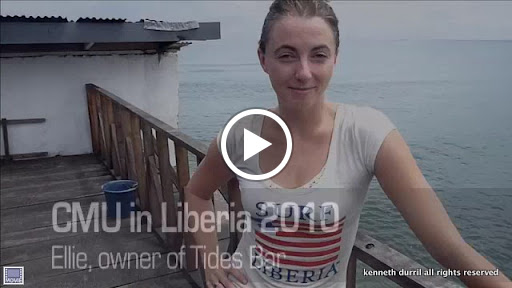
Yoga is not something I expected to find in Liberia. I assumed that people would have far more important matters to worry about and that the benefits of practicing yoga would not be appreciated. Despite my initial thoughts, I heard about a yoga class during my first 24 hours in the country. Not only did I hear about a yoga class, I found out that two instructors offer classes. The demand should not surprise anyone because ex-pats, like other migrant groups, bring elements of comfort from home and there is little as easy to transport as yoga, a practice of the mind and body; no additional material is necessary.
Yoga is not only easy to transport, it can provide a respite in and from a challenged country. This makes it a welcome outlet for people who are in a foreign land, especially one that is post-conflict. The war destroyed western comforts like 24-hour electricity and city water. Its devastation also left a lot of wounded individuals, physically and emotionally, and these are often the people that ex-pats seek to aid. Many aid-workers, commonly ex-pats, push themselves to solve as many issues as possible, but there is always more to be done. This is often compounded by the small size of many organizations. It seems to contribute to loneliness and can lead to burnout. The emotional burden is high, even in light of the tremendous impact that a smart and committed individual can make.
While the yoga class was a perfect diversion for me, it would work well for Liberians too. Ellie, the instructor, teaches classes targeted at Liberians too, but none came to this class. The lack of local accents reminded me of the distinct communities that exist in the country, those who stayed through the conflict, those who've returned, foreign residents and ex-pats. This is especially true because I believe that Liberians and other locals would pay for yoga classes. As a product, I believe that yoga is very fitting for Liberia's strong social sense and the high value that Liberians place on training of all sorts. The idea that yoga wasn't something that I would find in Monrovia continues to diminish as I learn about more about Liberia. Monrovia is urban and dynamic and it can have all of the things that the combination brings.
Thursday, June 17, 2010
"What are you going to do with that fish?"
Amos, a man that works at the apartment-complex we stay at who has become a good friend, asks me, “What are you going to do with that fish?”
We are walking back from the market on Benson Street in Monrovia where I had just purchased a small fresh fish. I find myself miming with my hands when I speak even though Amos speaks perfect English, Liberia is an English-speaking nation. I picked up the miming habit from my time in the Peace Corps, teaching English in the Republic of Georgia, and now it has become a terrible habit of speaking with my hands even when I don’t need to.
“Well, I usually just filet a fish and then fry it with a little oil. Sauté it.” I say, miming the fish with one hand and the knife with my other hand.
Amos disagrees.
We decide instead that Amos will show me how to make a local style of fish soup. It’s called ‘Pepper Soup’ because it calls for several of the very hot habanero-ish local Liberian peppers.
Back at the apartment Amos de-scales the fish and cuts it into width-wise chunks unlike the traditional length-wise cut of a filet. The upside is of course you keep more of the fish, the downside is that all of the bones are still there.
I bring a small pot of water to boil on our propane stove and add the fish, head included. Then we add the other ingredients: half an onion cut into strips, two chicken bouillon cubes, 6 Liberian peppers, a plentiful portion of salt and finally some black pepper. I also prepare a small bowl of rice because Pepper Soup is meant to be served with rice.
Unfortunately I do not have time to eat the soup after it’s finished, instead I am late to see the England vs. USA game of the WorldCup at a nearby bar. The soup waits until morning in our fridge.
In the morning I discover that the soup is almost too spicy for me but has an amazing broth. The cooking style makes sense to me. A good broth is more important when meat is so expensive. You can add more water and feed more people if the broth is that good. To filet a fish and throw away the head seems wasteful now.
-
When telling the story to my Mom over the phone she asked, “Well what do you do with the bones?”
“You spit them out” I said smugly. It seemed so obvious to me by then; my third week in Liberia.
We are walking back from the market on Benson Street in Monrovia where I had just purchased a small fresh fish. I find myself miming with my hands when I speak even though Amos speaks perfect English, Liberia is an English-speaking nation. I picked up the miming habit from my time in the Peace Corps, teaching English in the Republic of Georgia, and now it has become a terrible habit of speaking with my hands even when I don’t need to.
“Well, I usually just filet a fish and then fry it with a little oil. Sauté it.” I say, miming the fish with one hand and the knife with my other hand.
Amos disagrees.
We decide instead that Amos will show me how to make a local style of fish soup. It’s called ‘Pepper Soup’ because it calls for several of the very hot habanero-ish local Liberian peppers.
Back at the apartment Amos de-scales the fish and cuts it into width-wise chunks unlike the traditional length-wise cut of a filet. The upside is of course you keep more of the fish, the downside is that all of the bones are still there.
I bring a small pot of water to boil on our propane stove and add the fish, head included. Then we add the other ingredients: half an onion cut into strips, two chicken bouillon cubes, 6 Liberian peppers, a plentiful portion of salt and finally some black pepper. I also prepare a small bowl of rice because Pepper Soup is meant to be served with rice.
Unfortunately I do not have time to eat the soup after it’s finished, instead I am late to see the England vs. USA game of the WorldCup at a nearby bar. The soup waits until morning in our fridge.
In the morning I discover that the soup is almost too spicy for me but has an amazing broth. The cooking style makes sense to me. A good broth is more important when meat is so expensive. You can add more water and feed more people if the broth is that good. To filet a fish and throw away the head seems wasteful now.
-
When telling the story to my Mom over the phone she asked, “Well what do you do with the bones?”
“You spit them out” I said smugly. It seemed so obvious to me by then; my third week in Liberia.
For everything, a battery
Each morning, the power at our apartment building goes out for a short time. It is a fairly predictable schedule; sometime between 7:00 and 7:30, the lights will flicker out and the room will dim to the available sunlight. This outage occurs as the electrical generator is refilled with diesel. Our building has 24 hour electricity and that is far more than the vast majority of the country. Liberia seems to run on diesel, but the generator is just one example of dedicated power generation.
Without a stable grid system, battery generation is also key. Mobile phones are not just pervasive because they allow people to communicate, they are pervasive because they work more consistently than anything else for the price because of great batteries. If they allowed only 30 minutes of talk time and needed to be recharged more than once every two days on standby, they wouldn't fit the environment. The environment is inconsistent, yet the phone persists.
Notebook computers, like mobile phones, offer flexibility that is requisite with limited electricity, but Liberia also has limited space in its offices. Due to a lack of infrastructure maintenance, I expect that my office space might just be off limits. The inconvenience may only be temporary, but disruptive for that time. The inconsistent power can mean no air conditioning and has several times. Air conditioning is optional parts of the United States, but in a tropical area, the humidity and heat can really dampen productivity. Having a laptop at least allows a worker to attempt to find AC. Having a portable computer could really add days to to productivity each year and in ways that someone used to American standards might not guess.
For all of the individual freedom that batteries allow, I'd prefer the demand for them be built on better shared systems. Government workers are not road warriors for the most part. They sit at a fixed location and do a many narrow scope tasks each day. The environment is prescribed and the systems that support it should be as predictable. Coordination is hard and there is nothing like individual freedom to remind one of its difficulty.
The systems that drove mobile phone and notebook adoption in the United States are very different from what drives them in Liberia, yet the resulting products serve both areas. Seeing an iPhone in Monrovia is not common compared to $20 Nokias, but the base functionality is the same, people want to talk from where they are and need a reliable product. The commonality is unifying despite the wealth disparity that exists between these countries. Then again, not much allows a common sense of the world like sunlight at 7:15 am. If only Monrovia had a good coffee shop to go along with that light.
Tuesday, June 15, 2010
World Cup in Africa
Today during lunch, we went to a spot we were confident would have the football match on the tele. We caught the end of the New Zealand Vs. Slovakia match. It was quite an ending. New Zealand scored in the final seconds of injury time to tie the game, 1-1!
Then upon returning to the office, we periodically heard roars, cheers, and not as often but occasionally boos from the street. It has become a daily occurance. It feels like we are the only ones in the city of Monrovia diligently working. I am convinced that every television in Liberia is tuned to the World Cup; at least during business hours.
There are many reasons for Liberians to be enthralled with this years matches. One reason- though likely not the most important, as I will explain - is that the continent of Africa is hosting the world cup for the first time in South Africa. Another is that Africa is fielding 6 teams of the 32 teams participating - Algeria, Cameroon- who didn't fair well against Japan, Cote d'Ivoire, Ghana, Nigeria and South Africa.
This brings me to my last reason, which I think is important. Three of the six African teams are from West Africa. And Liberians (at least the Liberians I have watched games with) have a sense of connection with other West African Nations.Why is this? The region has been plagued with problems - corruption, economic and political instability, HIV/AIDS epidemic, food shortages. Their experience is largely common, even if that common experience was in violent conflict between and among ethnic groups that are found in many of these countries.
In 1975 at the Treaty of Lagos the West African countries came together to form ECOWAS (Economic Community of West African States). Perhaps the beginning of these modern nations recognizing common interests and goals for the region, and providing a framework in which to manage conflict...together. Perhaps this was the formation of sociopolitical connections in the region, perhaps not. So, when in Liberia, I am going to follow the crowd and cheer for Nigeria, Ghana and Cote d'Ivoire. Oh....they cheer for the US too, so there is no conflict of interest
Then upon returning to the office, we periodically heard roars, cheers, and not as often but occasionally boos from the street. It has become a daily occurance. It feels like we are the only ones in the city of Monrovia diligently working. I am convinced that every television in Liberia is tuned to the World Cup; at least during business hours.
There are many reasons for Liberians to be enthralled with this years matches. One reason- though likely not the most important, as I will explain - is that the continent of Africa is hosting the world cup for the first time in South Africa. Another is that Africa is fielding 6 teams of the 32 teams participating - Algeria, Cameroon- who didn't fair well against Japan, Cote d'Ivoire, Ghana, Nigeria and South Africa.
This brings me to my last reason, which I think is important. Three of the six African teams are from West Africa. And Liberians (at least the Liberians I have watched games with) have a sense of connection with other West African Nations.Why is this? The region has been plagued with problems - corruption, economic and political instability, HIV/AIDS epidemic, food shortages. Their experience is largely common, even if that common experience was in violent conflict between and among ethnic groups that are found in many of these countries.
In 1975 at the Treaty of Lagos the West African countries came together to form ECOWAS (Economic Community of West African States). Perhaps the beginning of these modern nations recognizing common interests and goals for the region, and providing a framework in which to manage conflict...together. Perhaps this was the formation of sociopolitical connections in the region, perhaps not. So, when in Liberia, I am going to follow the crowd and cheer for Nigeria, Ghana and Cote d'Ivoire. Oh....they cheer for the US too, so there is no conflict of interest
Drafting Industrial Policy
One of my projects is to assist a senior policy analyst with the Ministry of Commerce and Industry to draft Liberia's Industrial Policy. He is a very competent man, and therefore overworked, over-committed and serving on many committees. Thus much of the work in drafting a policy has been given to me - which is good and bad. Let me explain.
First I have been given a great responsibility. One I am qualified to do? probably not. But it is a project I am excited about and I think have the necessary skills to make it a success. I am in the process of speaking with various stakeholders. An important first step is getting buy-in and input from about key question from key stakeholders. The first question that comes to mind is - Why an Industrial Policy?
Given the past 40 or so years and seeing one failed industrial policy after another, one thinks that nothing good can come from the drafting of an industrial policy. I am thinking mostly of Latin American countries, borrowing ideas from the Washington Consensus, resulting in less than desirable outcomes. The effects of which we are seeing know with leaders rising to power that go to the other extreme - Hugo Chavez in Venezuela and Evo Morales in Bolivia. The other often illustrated examples are those of the Asian economies which arguably used government interventions and subsidies in markets more successfully. But it seems that this was due to much trial and error policy making - as many went through periods where their industrial policies reflected different ideological approaches or strategies.
So the next question is what will be Liberia's intention in drafting a policy?
I would like to see the Industrial Policy move beyond the characteristics of what has become traditional Industrial Policy. Liberia should benefit most from policy-making that considers and develops network of linkages with private groups, business associations and NGOs that possess valuable information that inform the crafting of effective policies which have to potential to overcome market barriers to growth.
What barriers to economic growth exist in Liberia? Given limited resources and capacity the exhaustive list is unknown by a single actor or sector. A possible list includes: lack of knowledge about what industries if developed will be competitive, lack of co-ordination of infrastructure and other investments, human capital development needs, underdeveloped credit market and lack of finance, corruption or bribery, as well as inefficient and ineffective laws and regulations. But the fact that one single actor does not know the specifics of each barriers, leads one to believe that a collaborative approach may be most effective.
Perhaps a way to move forward would be to outline a process to form a committee or council that creates strategic linkages with the private sector. I came across this concept of Industrial Policy by process in a paper titled An Indsutrial Policy for the Twenty-First Century, by a professor at the Kennedy School, Dani Rodrik. As Dr. Rodrik proposes this council might be charged with gathering information about objectives, discover where barriers exist, distribute and coordinate responsibilities for solutions, and importantly evaluate outcomes (maintaining the ability to end policies that are not successful).
Looking at Industrial Policy in this context allows it to be an iterative process where mistakes will be made, though can be efficiently and effectively corrected. In contrast, with a more traditional formulation of Industrial Policy, one is stuck with the decisions made until the policy itself is retired, not the individual items with-in the policy.
The next question that would need to be asked is does the government currently have the capacity to oversee such a process; assuring that policy making is transparent, and protocols are developed so that the collaboration with the private sector doesn't turn into collusion. Maybe not. But in an ideal world this is how I think Liberia should move forward. And perhaps they will at some point. But perhaps not.
In the next few months at the very least I hope to develop policy options that are perhaps less robust and comprehensive, but are realistic, manageable, and are ideologically somewhere in between letting the markets run wild, and complete government control. Hopefully we will develop policy that will effectively enable and accelerate markets to do what they do best - efficiently allocate resources and produce growth.
First I have been given a great responsibility. One I am qualified to do? probably not. But it is a project I am excited about and I think have the necessary skills to make it a success. I am in the process of speaking with various stakeholders. An important first step is getting buy-in and input from about key question from key stakeholders. The first question that comes to mind is - Why an Industrial Policy?
Given the past 40 or so years and seeing one failed industrial policy after another, one thinks that nothing good can come from the drafting of an industrial policy. I am thinking mostly of Latin American countries, borrowing ideas from the Washington Consensus, resulting in less than desirable outcomes. The effects of which we are seeing know with leaders rising to power that go to the other extreme - Hugo Chavez in Venezuela and Evo Morales in Bolivia. The other often illustrated examples are those of the Asian economies which arguably used government interventions and subsidies in markets more successfully. But it seems that this was due to much trial and error policy making - as many went through periods where their industrial policies reflected different ideological approaches or strategies.
So the next question is what will be Liberia's intention in drafting a policy?
I would like to see the Industrial Policy move beyond the characteristics of what has become traditional Industrial Policy. Liberia should benefit most from policy-making that considers and develops network of linkages with private groups, business associations and NGOs that possess valuable information that inform the crafting of effective policies which have to potential to overcome market barriers to growth.
What barriers to economic growth exist in Liberia? Given limited resources and capacity the exhaustive list is unknown by a single actor or sector. A possible list includes: lack of knowledge about what industries if developed will be competitive, lack of co-ordination of infrastructure and other investments, human capital development needs, underdeveloped credit market and lack of finance, corruption or bribery, as well as inefficient and ineffective laws and regulations. But the fact that one single actor does not know the specifics of each barriers, leads one to believe that a collaborative approach may be most effective.
Perhaps a way to move forward would be to outline a process to form a committee or council that creates strategic linkages with the private sector. I came across this concept of Industrial Policy by process in a paper titled An Indsutrial Policy for the Twenty-First Century, by a professor at the Kennedy School, Dani Rodrik. As Dr. Rodrik proposes this council might be charged with gathering information about objectives, discover where barriers exist, distribute and coordinate responsibilities for solutions, and importantly evaluate outcomes (maintaining the ability to end policies that are not successful).
Looking at Industrial Policy in this context allows it to be an iterative process where mistakes will be made, though can be efficiently and effectively corrected. In contrast, with a more traditional formulation of Industrial Policy, one is stuck with the decisions made until the policy itself is retired, not the individual items with-in the policy.
The next question that would need to be asked is does the government currently have the capacity to oversee such a process; assuring that policy making is transparent, and protocols are developed so that the collaboration with the private sector doesn't turn into collusion. Maybe not. But in an ideal world this is how I think Liberia should move forward. And perhaps they will at some point. But perhaps not.
In the next few months at the very least I hope to develop policy options that are perhaps less robust and comprehensive, but are realistic, manageable, and are ideologically somewhere in between letting the markets run wild, and complete government control. Hopefully we will develop policy that will effectively enable and accelerate markets to do what they do best - efficiently allocate resources and produce growth.
Sunday, June 13, 2010
I know I'm here, but where is here?
Liberia's systems are not always clear to outsiders. Taxis travel specified routes and passengers flag those routes through a series of hand gestures. Waterside, the outdoor market, provides few clues to its workings even after hours of exploration. On top of that, Liberian English has diverged so greatly from standard American English, that several months of learning are needed to understand it. Once a person needs a system, he learns it and seems to become comfortable quickly. However, systems like Liberia's are custom, informal, and to internal to Liberia. Formal systems that should be clear to anyone entering Liberia are sometimes left to custom as well. This is most evident and particularly problematic in Liberia's address system.
Liberia has a standard format according to its Ministry of Posts and Telecommunications. Its prescribed location standard is the nearest intersection. This convention may lack precision, but it is probably better than using landmarks which is a commonly accepted informal practice for giving direction. The current standard also includes a post code, city and area code, but in my review of thousands of government records, I've never seen either codes listed or required. The problem of adhering to the standard comes from both government and the general public.
Even official documents are not structured to require the current standard. Address fields are listed as address without being subdivided. This allows the public to include only a neighborhood or a street name, without a number, city, country or even a cross street. This is most common for Monrovia addresses. Addresses outside of Monrovia usually include a town name, but this does not allow outsiders to participate. So, this is sufficient for locals, those with knowledge of Liberia, to operate, but even for Liberians, the assumptions of the search based on a street name must are often insufficient.
Liberia's postal service is undergoing reform to meet international standards according to a June, 2009 AllAfrica.com article. The system will be similar to that used in The United States. The Universal Postal Union, a division of the United Nations, began reforms in 2006. The reform plan's author considers the plan to have been successfully implemented with a few minor exceptions according to the article. The plan concludes in 2015. The American government evaluated Liberia's service in 2007. After this, The United States donated equipment to further the Liberian effort in March 2008. Since then, efforts toward implementation have been unclear. The Ministry of Post and Telecom had a public meeting about the update in November of 2009, but I could find not record of follow-up activity.
Despite having a plan and receiving outside resources, no such reform is clear at the Ministry of Commerce and Industry. Business records from 2009 still lack city and county information for many firms. Even when sending a letter within Monrovia, Ministry employees expect to use a courier, an expensive activity that is also limited in its scale. While mobile telephone calls are preferred communication and have ability to reach people instantly and at any given location, they lack status as official documents. In 2010, two years after American and UN consultant helped to revise Liberia's system, no improvements have been implemented.
Liberia's system is harmful to the nation for its inefficiency and is a barrier to trade. This harm is shown in several ways. This lack of progress restricts movement of residents by requiring knowledge through experience instead of providing a clear logic for them to follow. A lacking address system also discourages the growth of firms because having more than one location can easily cause confusion. A standardized system would not only allow Liberia to interact internally, it would also allow it to send goods and services internationally with far greater ease as well. A nation cannot trade well when its partners cannot ship to the doorstep of their customers and partners. International export will be greatly important to Liberia's redevelopment efforts. The urgency of reform becomes even greater in this light.
The government needs a reformed postal service as much or more than other organizations, yet this problem is exacerbated by non-enforcement of standard addressing by government agencies. Government is the place to start implementation of this reform and more political will must be shown to make it happen. The leg work has been done. Now, ministries must dust off plans that have gathered dust for two years and promote this societal upgrade.
Without a standard postal system, Liberia will be hampered by the most simple efforts. Even in the age of the Internet and the ubiquity of mobile phones, land addresses are critical to a country. The movement of physical goods and actual people has no digital substitute. Liberia must create a base to leap from and it must do it with urgency.
Sources:
The Ministry of Posts & Telecomm. Hosts a Donors' Conference on National Postal Address System
Friday, 20th November 2009
http://www.mopt.gov.lr/press.php?news_id=21
Liberia: Postal System Recovering
Allafrica.com 1 Jun 2009
www.allafrica.com/stories/200906010279.html
Liberians Soon May Be Getting More Mail, with U.S. Help
Department of State, press release, 7 Apr 2008
http://www.america.gov/st/develop-english/2008/April/20080407135051TDpper0.0736658.html
Thursday, June 10, 2010
MSME (micro, small and medum sized enterprises)
I believe that one path to equatable and sustainable growth for Liberia will be from the development of micro, small, medium sized enterprises.
There is a great entrepreneurial spirit. Everyone wants to start a business. Partly because of imitation - starting a small business is what most people do. But also because there are few other opportunities to provide for oneself or ones family. It seems that most people are in government, or they operate a MSME or they are in government and they operate a MSME. There are few other opportunities.
This entrepreneurial spirit however lacks creativity and innovation. Many of the businesses established mimic what others are already doing. There has not been the step taken to differentiate businesses, provide a new innovative service or product, or simply providing the same service or product in a new way.
The streets are litterally crowded with street vendors and money changers. The goods that are sold and the services that are provided however are the exact same from street corner to street corner. I would confidently walk out any door in Monrovia and expect to see someone selling scratch cards (a phone card used to refill minutes on ones cellphone), someone shinning shoes, someone selling candies, someone selling umbrellas - presumably because it is the rainy season. The problem is that all these services and products are interchangable. The market is saturated, and there is no room or opportunity to grow these micoenterprises to employ others, or to provide an increasing standard of living for those that participate in this industry.
There is also little innovation in transportation. Share taxis and "pem pem boys" flood the streets. They provide a much needed service - transporting folks form point A to point B and in fact are the de facto public transportation in Monrovia. A system of hand singles has even been developed so that people waiting for a ride can denote the direction they are going - either straight up the road, splitting off from the road to the left or to the right - all in efforts to facilitate the efficient use of transportation by a large mass of people. But again there is little innovation and the traffic created by the immense number of people operating in this industry crowds the existing infrastructure and makes moving from point A to point B very slow, and at times scary.
This sector however has huge opportunity to create a large impact for the economy of Liberia. The public interest in entrepreneurial endeavors can be captured and directed to more productive activities. If individuals are provided the opportunity to develop necessary skills, and if they have access to the necessary financial services and if confidence in the political and economic stability can be fostered (all big "if's") then perhaps the MSMEs of the country can be the economic engine that brings sustainable and equitable growth to Liberia.
There is a great entrepreneurial spirit. Everyone wants to start a business. Partly because of imitation - starting a small business is what most people do. But also because there are few other opportunities to provide for oneself or ones family. It seems that most people are in government, or they operate a MSME or they are in government and they operate a MSME. There are few other opportunities.
This entrepreneurial spirit however lacks creativity and innovation. Many of the businesses established mimic what others are already doing. There has not been the step taken to differentiate businesses, provide a new innovative service or product, or simply providing the same service or product in a new way.
The streets are litterally crowded with street vendors and money changers. The goods that are sold and the services that are provided however are the exact same from street corner to street corner. I would confidently walk out any door in Monrovia and expect to see someone selling scratch cards (a phone card used to refill minutes on ones cellphone), someone shinning shoes, someone selling candies, someone selling umbrellas - presumably because it is the rainy season. The problem is that all these services and products are interchangable. The market is saturated, and there is no room or opportunity to grow these micoenterprises to employ others, or to provide an increasing standard of living for those that participate in this industry.
There is also little innovation in transportation. Share taxis and "pem pem boys" flood the streets. They provide a much needed service - transporting folks form point A to point B and in fact are the de facto public transportation in Monrovia. A system of hand singles has even been developed so that people waiting for a ride can denote the direction they are going - either straight up the road, splitting off from the road to the left or to the right - all in efforts to facilitate the efficient use of transportation by a large mass of people. But again there is little innovation and the traffic created by the immense number of people operating in this industry crowds the existing infrastructure and makes moving from point A to point B very slow, and at times scary.
This sector however has huge opportunity to create a large impact for the economy of Liberia. The public interest in entrepreneurial endeavors can be captured and directed to more productive activities. If individuals are provided the opportunity to develop necessary skills, and if they have access to the necessary financial services and if confidence in the political and economic stability can be fostered (all big "if's") then perhaps the MSMEs of the country can be the economic engine that brings sustainable and equitable growth to Liberia.
The cycle of conflict
I went out for a drink last night with the assistant manager of our apartment complex. He is about 31 years old, and a very intelligent man. He is from Nimba county, in the north east of Liberia. At the age of 17 he moved to Monrovia to put himself through school. His father was a manager at the Bong Mines and was employed by a company that I can't recall. If I could describe him in a short phrase I would say that he has a kind heart. Though that phrase is not sufficient to describe him. He is most definately a people person - from the day that we moved in, it was difficult to escape his presence with out having in depth conversations.
The first conversation we had was about religion. After his father lost his job and all of his savings during the war, he moved to Monrovia - as many did during the civil war - and became a minister at the local Methodist church. Religion has played a large part in his life, and has brought him to think about issues of the human condition in a profound way.
The second time we spoke, we discussed history. He reiterated some of what I already knew about Liberian political history. Liberia was founded by former American slaves, and declared independence in 1847; there was a coup in 1980 in which a 28 year old Master Sergeant in the Liberian Army, Samuel K. Doe assassinated president Tolbert; later in 1989 Charles Taylor leader of the National Patriotic Front of Liberia (NPFL) led an armed uprising into liberia opposing the government of Doe; Prince Johnson leader of a fraction group of the NPFL captured Monrovia and killed Samuel Doe; The country descended into civil war, which didn't end until 1996, when Charles Taylor was elected president.
Most of this I knew but then the conversation changed tone and was diverted from a mere discussion about historical events. My friend was able to convey to me a more nuanced understanding of the political and social forces at play. He further explored the personal psyche of the men that were involved in Liberia's troubled past. He did not excuse their actions or proclivity to violence - but explained the context for which this violence took place.
One thing that I have been warned of since being here, is to be careful of the mob mentality. If groups of people forming, or if any disturbances become apparent in a crowd, I should move to somewhere safe. Although I have not seen this in person, I have heard of incidences from many people - Liberians, Ex-pats and Re-pats.
This mentality explains, in part, what my friend was conveying to me about the phyche of these men and the violent coups that that occurred during this time. These men were the leaders during this disastrous time for Liberia, but they were not solely to blame or in complete control of the violence that occurred. To remain in power and to protect themselves they allowed the fear and lack of trust amongst the people of Liberia to exacerbate the vicious cycle of conflict. And they did anything to stop it, out of fear for the safety, security or perhaps for the sake of holding onto power.
I don't know if I completely support this analysis, though I value the perspective and felt I had gained greater insights and understanding from our dialogue.
But then our conversation changed. We began to discuss the current political and social environment in Liberia, and the strides that the current government is taking to end this cycle of violence. We both agreed that Madame President Sirleaf is a brave women. And a women with audacious goals, but realistic hopes for Liberia. The social and political dynamic is shifting, although slowly. But perhaps the pace is necessary. It takes much planning, policy making and intentional action to reshape a society that was for so long plagued by and accustomed to armed conflict being the flawed solution to political and social inequalities.
The first conversation we had was about religion. After his father lost his job and all of his savings during the war, he moved to Monrovia - as many did during the civil war - and became a minister at the local Methodist church. Religion has played a large part in his life, and has brought him to think about issues of the human condition in a profound way.
The second time we spoke, we discussed history. He reiterated some of what I already knew about Liberian political history. Liberia was founded by former American slaves, and declared independence in 1847; there was a coup in 1980 in which a 28 year old Master Sergeant in the Liberian Army, Samuel K. Doe assassinated president Tolbert; later in 1989 Charles Taylor leader of the National Patriotic Front of Liberia (NPFL) led an armed uprising into liberia opposing the government of Doe; Prince Johnson leader of a fraction group of the NPFL captured Monrovia and killed Samuel Doe; The country descended into civil war, which didn't end until 1996, when Charles Taylor was elected president.
Most of this I knew but then the conversation changed tone and was diverted from a mere discussion about historical events. My friend was able to convey to me a more nuanced understanding of the political and social forces at play. He further explored the personal psyche of the men that were involved in Liberia's troubled past. He did not excuse their actions or proclivity to violence - but explained the context for which this violence took place.
One thing that I have been warned of since being here, is to be careful of the mob mentality. If groups of people forming, or if any disturbances become apparent in a crowd, I should move to somewhere safe. Although I have not seen this in person, I have heard of incidences from many people - Liberians, Ex-pats and Re-pats.
This mentality explains, in part, what my friend was conveying to me about the phyche of these men and the violent coups that that occurred during this time. These men were the leaders during this disastrous time for Liberia, but they were not solely to blame or in complete control of the violence that occurred. To remain in power and to protect themselves they allowed the fear and lack of trust amongst the people of Liberia to exacerbate the vicious cycle of conflict. And they did anything to stop it, out of fear for the safety, security or perhaps for the sake of holding onto power.
I don't know if I completely support this analysis, though I value the perspective and felt I had gained greater insights and understanding from our dialogue.
But then our conversation changed. We began to discuss the current political and social environment in Liberia, and the strides that the current government is taking to end this cycle of violence. We both agreed that Madame President Sirleaf is a brave women. And a women with audacious goals, but realistic hopes for Liberia. The social and political dynamic is shifting, although slowly. But perhaps the pace is necessary. It takes much planning, policy making and intentional action to reshape a society that was for so long plagued by and accustomed to armed conflict being the flawed solution to political and social inequalities.
Tuesday, June 8, 2010
Industry and Opportunity
It is estimated that 80 percent of Liberian Families' main source of income is from micro, small and medium sized enterprises (MSME). The case for supporting these small business in Liberia is not difficult to make. All countries have large numbers of small businesses. In some countries, they contribute to national income and job creation. In others the bulk of small enterprises continue year after year with negligible output and job creation. The government has the opportunity to support the countries MSMEs so that they are in the former category and not the latter.
Because of the Liberia's starting point of great income disparities, to achieve equitable economic growth, much focus should be placed on extending economic opportunities to the 75% of Liberians that are living on less than $1 per day. Many of these Liberians are supporting families by working in the informal sector - economic activity neither taxed nor monitored the government.
A division of the Ministry of Commerce and Industriy that works to provide resources to business owners and facilitate the transition into the formal sector. The Division of SMEs was created to ask the questions, what can the government do to increase successful outcomes for SMEs. And I am pleased that this is where I will be working for part of my time in Liberia.
The other part of my time will be spent reviewing and editing the Industry Policy of Liberia. In collaboration with my new colleagues - who have been great to work with - we will finalize the industrial policy by the end of June. This document will serve as the guiding framework for the Liberian Government, in the development of Regulations and legislation to support the growth of Industry and Commerce.
Kenneth is also placed with the Ministry of Commerce and Industry, Travis is working with the Ministry of Finance. We started our jobs on Monday and transitioned from the informal to formal intern status.
Because of the Liberia's starting point of great income disparities, to achieve equitable economic growth, much focus should be placed on extending economic opportunities to the 75% of Liberians that are living on less than $1 per day. Many of these Liberians are supporting families by working in the informal sector - economic activity neither taxed nor monitored the government.
A division of the Ministry of Commerce and Industriy that works to provide resources to business owners and facilitate the transition into the formal sector. The Division of SMEs was created to ask the questions, what can the government do to increase successful outcomes for SMEs. And I am pleased that this is where I will be working for part of my time in Liberia.
The other part of my time will be spent reviewing and editing the Industry Policy of Liberia. In collaboration with my new colleagues - who have been great to work with - we will finalize the industrial policy by the end of June. This document will serve as the guiding framework for the Liberian Government, in the development of Regulations and legislation to support the growth of Industry and Commerce.
Kenneth is also placed with the Ministry of Commerce and Industry, Travis is working with the Ministry of Finance. We started our jobs on Monday and transitioned from the informal to formal intern status.
The New Apartment
We moved into our apartments on Saturday. Kenneth and Travis took one of the two-bedroom apartment and I the other. I am under the impression that I will have another intern moving in with me, but for now I have quite-a-nice flat all to myself.
Upon arriving to the apartments today, we were quite impressed. The rooms are large and fully furnished. There is a nice kitchen and bathrooms with plenty of room. We also have 24-hour electricity, which is unheard of in Monrovia. I am not sure if we are plugged into the main grid, but if we are, generator costs are about 42 cents per KWH. This cost is much higher than in the US, where average costs are more like 2-10 cents. This is mostly because the fuel used in Liberia is diesel.
Speaking for myself I was surprised with our housing; it is quite nice! I appreciate greatly the Liberian Government arranging this housing for us. But I also feel like we are a bit disconnected. Not only do we have 24-hour electricity but we also have 24-hour security. Although my friends and family can rest soundly knowing that we are completely safe, it seems like we are in a fortress under lock and key.
I hope to make a concerted effort to not be disconnected and removed from our surroundings. One of the appeals of this trip – of which there are many – was to experience a community that is very foreign to a graduate student living in Pittsburgh and going to Carnegie Mellon. Being in Africa - and specifically Liberia - offers an opportunity I do not want to pass up. I hope I do not hide behind the comfort and air-conditioning in our apartments; I hope to venture out into the heat.
Upon arriving to the apartments today, we were quite impressed. The rooms are large and fully furnished. There is a nice kitchen and bathrooms with plenty of room. We also have 24-hour electricity, which is unheard of in Monrovia. I am not sure if we are plugged into the main grid, but if we are, generator costs are about 42 cents per KWH. This cost is much higher than in the US, where average costs are more like 2-10 cents. This is mostly because the fuel used in Liberia is diesel.
Speaking for myself I was surprised with our housing; it is quite nice! I appreciate greatly the Liberian Government arranging this housing for us. But I also feel like we are a bit disconnected. Not only do we have 24-hour electricity but we also have 24-hour security. Although my friends and family can rest soundly knowing that we are completely safe, it seems like we are in a fortress under lock and key.
I hope to make a concerted effort to not be disconnected and removed from our surroundings. One of the appeals of this trip – of which there are many – was to experience a community that is very foreign to a graduate student living in Pittsburgh and going to Carnegie Mellon. Being in Africa - and specifically Liberia - offers an opportunity I do not want to pass up. I hope I do not hide behind the comfort and air-conditioning in our apartments; I hope to venture out into the heat.
Friday, June 4, 2010
Liberia Video
We recorded our initial thoughts on our trip before we left Pittsburgh in May. We asked two questions: 1) what inspired us to come? and 2) what were our expectations upon arriving?
We were hopeful and full of wonder before arriving. It is a state that we expect to vary. Our expectations will change before we return. Despite that, we can use these recordings to gauge our progress and our mindsets. We at least have a record to judge ourselves against. We are facing the unknown and all that comes with it. Even a week after arrival, our expectations have been challenged on several levels. We will continue to comment as the summer continues.







Lunch with the Chief of Security
After our morning introductions with the Ministers and staff, I stepped outside of the Ministry of Commerce and Industry, where Kenneth and I will work for the next four weeks. The chief of security at the Ministry came up to me, I think feeling like he was to protect me, while I was out on the street. He kindly offered to show me and my colleagues around the neighborhood after our day of orientation was over. We gladly took him up on his offer.
He showed us around the streets crowded with pedestrians and people selling wares in an ad-hoc open air market. He was happy to introduce us to his older brother, an employee at the Ministry of Transportation, and his mother an employee at the Ministry of Immigration - all in the same area. This was our first contact with Liberians in this intimate way. We were on the crowded streets, removed from the airconditioned rooms of the Ministries.
After our tour we went to a local hotel. The Chief of Security at the Ministry sat with us while we ate. He is a 27 year old who, up to this point, has been the most open with us about his life story and his experience during the 14 year civil war - which left his country in shambles. It was very interesting hearing someone my age speak about their experience and perspective on war. To this point I had only read and heard from third parties the unimaginable acts that occurred during the war in Liberia. For the first time I received a first-hand account. To say the least I have a lot to reflect on and process.
He plays on a local soccer team and invited us to play. For a second I was convinced I should dust off my old soccer skills. Though most likely I will use my finely tuned viewing skills and go watch a game they have next week.
Why Liberia is SO expensive
Our first clue that Liberia was going to be an expensive trip was the quoted rent from the government, while we were planning: 1,000-1,500 USD. This being on par with rent in New York, we were quite shocked. Though we also thought this was unique to places with security where they like to place Americans. We found out when we got here this is not necessarily the case. There are of course inexpensive living options. We heard rumors of a Scottish employee of one of the ministries that lives in a single room without electricity or running water for 20 USD a month. We are still looking for permanent residence and hopefully will pay somewhere in between.
Second we were surprised that most prices are dollarized. The only time we have used the local Liberian Dollar (LD) is once for a taxi and when we have bought items from vendors on the street. Most food in restaurants is in USD, and is no less expensive than in America. You pay 5-12 USD per meal and we have spent 20 USD per day on food since arriving. We hope to have a place soon, with a kitchen so that we can limit our food expenditures. Lucky for me Travis and Kenneth are good cooks.
In short we have found that high prices are (in part) due to the large number of foreigners working for the government and NGOs - their salaries usually subsidized by an outside agency or fellowship program – and of course the large UN presence.
If or when international interest in Liberia wanes or the UN phases down their presence, there will be much less USD coming in from the outside and it seems that a large part of local demand will evaporate. I can only assume that prices will decrease and incomes will as well. I’m left with the question what will this mean to the stability of the political economy?
Second we were surprised that most prices are dollarized. The only time we have used the local Liberian Dollar (LD) is once for a taxi and when we have bought items from vendors on the street. Most food in restaurants is in USD, and is no less expensive than in America. You pay 5-12 USD per meal and we have spent 20 USD per day on food since arriving. We hope to have a place soon, with a kitchen so that we can limit our food expenditures. Lucky for me Travis and Kenneth are good cooks.
In short we have found that high prices are (in part) due to the large number of foreigners working for the government and NGOs - their salaries usually subsidized by an outside agency or fellowship program – and of course the large UN presence.
If or when international interest in Liberia wanes or the UN phases down their presence, there will be much less USD coming in from the outside and it seems that a large part of local demand will evaporate. I can only assume that prices will decrease and incomes will as well. I’m left with the question what will this mean to the stability of the political economy?
Thursday, June 3, 2010
Arrival
 After 26 hours of transit time, we landed in Monrovia without any troubles. We arrived in the late afternoon to a bright and wet day with high humidity. Passengers gripped the rail of the exit stairs as they descended to the tarmac from the Airbus A320 that seemed a bit out of time compared to its surroundings. The airfield was small and without the shopping mall feel of Brussels, Dulles or Pittsburgh. Everything was simple. The baggage area had a single carousel. The space contained about 3 large advertisements and that was the extent of its commercialization. The terminal had only 3 customs workers and a few security guards. Our flight was all they had to process. While each of them were efficient and orderly, nothing gleamed or seemed polished like in our previous airports. The airport was an excellent introduction to the utilitarianism of Liberia. This sparseness persisted outside of the airport and could be seen in the cement block buildings and numerous all terrain vehicles. It is in most things. The contrast to The States is great, but there are more important things to be changed.
Liberia’s Political Future
I have learned a great deal about Liberia over the past weeks. A country that I have not studied extensively - an experience common in American schools - I was surprised to find the common history that Liberia and America share. As a mondern state Liberia was founded in 1847 when the Republic of Liberia declared its independence from the American Colonization Society (ACS), becoming the first republic in Africa. After over one hundred years of non-indigenous rule in 1980 there was a coup that removed the rule of the Americo-Liberians, leaving in-place a military regime led by Samuel K. Doe. After nine-years of the Doe regime in power, the country descended into civil war. Civil War Ended when elections were held in 1997 facilitated by the involvement of ECOWAS (Economic Community of West Africa). Charles Taylor was elected in elections that were widely touted as free and fare, though some think not. Taylor served as President until his exile in Nigeria in 2003. Even under the Taylor regime there was still fighting. Other factions opposed his presidency and violently pursued his resignation.
Driving around Monrovia you can’t help but notice the UN's white cars with the UNMIL and UNDP insignia. Peace only came with international intervention in 2003. This peace was followed by a temporary government led by a widely renowned intellectual Amos Sawyer. International intervention and the relative peace and security laid the foundation for National Elections in 2005. Currently there are about 8,000 UN peacekeepers on the ground, which is down from the initial level of 15,000. As many others that I have met, I am left with the question what would Liberia be like with out the UN presence?
Although President Ellen Johnston Sirleaf's election in 2006 and the forward progress that has been made, is reason for optimism, it easy to become overly optimistic. Two important events are going to happen in the near future: elections in September 2011 and UN peacekeeping troops leaving the country. Depending on how the election process works and who is ultimately elected could impact the relations between various political groups. Some fear that UN withdrawal could provide the opportunity for those that have not seen or felt the impact of the governments Poverty Reduction Strategy or do not feel that their interests are represented in the political process to again take up arms - possibly leading to greater conflict.
If Liberia is able to continue building a foundation for a strong future and maintain stability and security through the elections and past the UN withdraw, I am optimistic about their future. But there is still much work to be done and I greatly appreciate the opportunity to be in Liberia and contribute what I can.
Driving around Monrovia you can’t help but notice the UN's white cars with the UNMIL and UNDP insignia. Peace only came with international intervention in 2003. This peace was followed by a temporary government led by a widely renowned intellectual Amos Sawyer. International intervention and the relative peace and security laid the foundation for National Elections in 2005. Currently there are about 8,000 UN peacekeepers on the ground, which is down from the initial level of 15,000. As many others that I have met, I am left with the question what would Liberia be like with out the UN presence?
Although President Ellen Johnston Sirleaf's election in 2006 and the forward progress that has been made, is reason for optimism, it easy to become overly optimistic. Two important events are going to happen in the near future: elections in September 2011 and UN peacekeeping troops leaving the country. Depending on how the election process works and who is ultimately elected could impact the relations between various political groups. Some fear that UN withdrawal could provide the opportunity for those that have not seen or felt the impact of the governments Poverty Reduction Strategy or do not feel that their interests are represented in the political process to again take up arms - possibly leading to greater conflict.
If Liberia is able to continue building a foundation for a strong future and maintain stability and security through the elections and past the UN withdraw, I am optimistic about their future. But there is still much work to be done and I greatly appreciate the opportunity to be in Liberia and contribute what I can.
What does it look like?
What does it look like?
Travel Posting
Green. Yes it is very green here and palm trees line the roads. We can see the Atlantic washing up on a lonely beach with a thin sand bar from the tree line down to the water. The buildings have the look of intermediate construction and mixed design; some construction is made with cinder blocks and concrete, some construction is thatched roofing and mud walls, some construction uses tin corrugated sheet metal roofing and several buildings are simply not yet finished.
The land is mostly flat and forested so if you can get on to a balcony the view is spectacular. One paved highway with many dirt roads leading off from it. The roads are filled with cars and small motorcycles. The motorcycles are used as one-seat taxis and their name is onomatopoeia for the sound of a horn beeping. “Peh-peh” The sound of a small annoying car horn beeping twice, “peh-peeeeeeeh!” The vowel is a long schwa sound. Some of the Peh-peh drivers wear helmets and some do not.
There are white UN SUVs all over the place.
Travel Posting
Green. Yes it is very green here and palm trees line the roads. We can see the Atlantic washing up on a lonely beach with a thin sand bar from the tree line down to the water. The buildings have the look of intermediate construction and mixed design; some construction is made with cinder blocks and concrete, some construction is thatched roofing and mud walls, some construction uses tin corrugated sheet metal roofing and several buildings are simply not yet finished.
The land is mostly flat and forested so if you can get on to a balcony the view is spectacular. One paved highway with many dirt roads leading off from it. The roads are filled with cars and small motorcycles. The motorcycles are used as one-seat taxis and their name is onomatopoeia for the sound of a horn beeping. “Peh-peh” The sound of a small annoying car horn beeping twice, “peh-peeeeeeeh!” The vowel is a long schwa sound. Some of the Peh-peh drivers wear helmets and some do not.
There are white UN SUVs all over the place.
Tuesday, June 1, 2010
Touching Ground
We arrived in Liberia yesterday. Upon exiting customs we were swarmed by a dozen or so nice young gentlemen happy to see visiting Americans. We are currently staying with Andrew, a young man from San Francisco working with the Ministry of Planning and Economic Affairs; his Fellowship being sponsored by a foundation. He will be in his position through the elections in November 2011.
Until next week, when we move to our more permanent housing, we are living on the third floor of a building 5 yards away from the Chinese Embassy. We have a clear view over the wall. I am surprised at the size of the Embassy, which is indicative of the presence of China in Liberia and all of Africa. I am under the impression they are here in part because of the rich natural resources. Liberia is rich in Rubber, Timber, iron ore, diamonds, coffee, cocoa, rice, cassava and bio-mass fuel. Much of which is underdeveloped – meaning great opportunity for growth. However future growth might be somewhat deceiving. Liberian GDP peaked in 1979, falling 91% to is lowest point in 1996. Although GDP is likely to be underreported for various reasons, Liberia has a lot of excess capacity, and strong expectations to meet. You might expect that growth would be much quicker; rebounding to previous levels of GDP. However that has not been the case based official numbers.
The owner of the house is the former Director of CID (Liberia’s version of the CIA) and currently working with the Ministry of Justice. He has quite a gorgeous house and we are quite comfortable.
We are visiting the Ministry of Planning and Economic Affairs today. We are not yet sure where we will be placed. Though it sounds like we are likely to start work at the Ministry of Commerce, the beginning of next week. This gives us time to blog, acclimate to the weather and the culture and settle in.
Over the next couple of days I hope to write two posts – the political and economic history of Liberia. This is to inform our readers, but more important it gives me the opportunity to develop my understanding of the political and economic conditions we will be working in. Thanks to our diligent research and to the individuals we visited in Washington, DC, and the people we are now working and living with in Liberia, I have great sources.
Subscribe to:
Comments (Atom)